
TL;DR
NDIS software trends 2026 highlight a shift toward AI automation, mobile-first platforms, advanced analytics, and adaptive compliance systems. Providers who adopt future ready NDIS technology can improve operational efficiency, ensure regulatory compliance, enhance participant outcomes, and scale sustainably. Strategic software investment is now a critical differentiator in a competitive, evolving NDIS landscape.
Why NDIS Software Evolution Matters in 2026
NDIS providers face mounting pressure from regulatory changes, funding constraints, and growing participant complexity. Smart technology choices separate thriving providers from those struggling to adapt. NDIS software trends 2026 reveal clear patterns: automation, mobile access, and intelligent analytics drive success.

Understanding NDIS software evolution helps providers make strategic technology decisions that support sustainable growth. The NDIS sector operates under tighter compliance expectations, reduced funding margins, and increasing participant complexity. In this environment, future NDIS technology becomes a core strategic asset influencing performance and long-term viability.
McKinsey research shows that 88% of organisations now use AI regularly in at least one business function, with dramatic productivity improvements across sectors. As the NDIS market matures, NDIS software innovation increasingly separates high-performing providers from those unable to adapt.
This technology roadmap outlines emerging NDIS tools, NDIS tech predictions, and practical guidance for aligning systems with future sector demands.
Ready to explore future-ready NDIS technology? Try Vertex360’s advanced platform with AI automation and mobile access built-in.
The Changing Landscape of NDIS Software Innovation
NDIS software innovation accelerates as providers demand platforms that go beyond basic billing and record management. Legacy systems designed for administration alone are being replaced by intelligent, connected ecosystems that support real-time decision making.
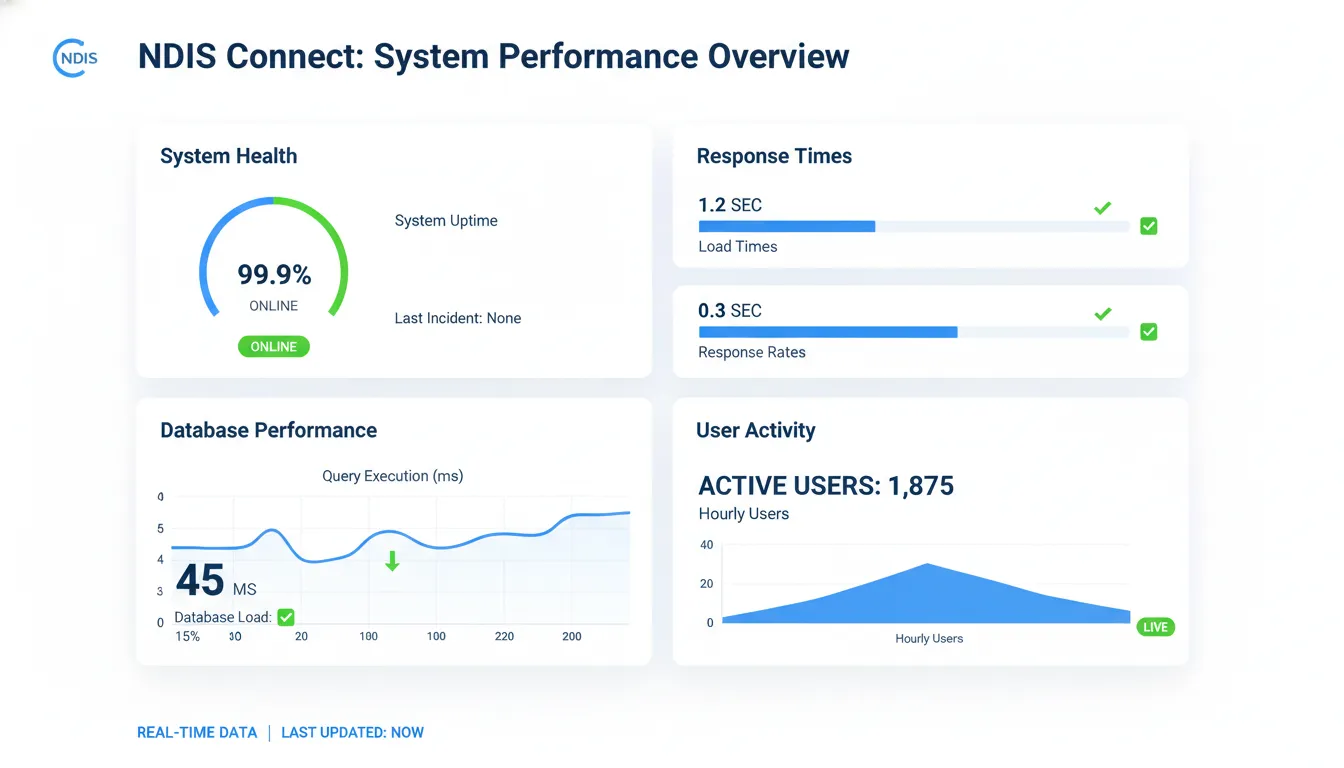
Future NDIS technology prioritises real-time visibility, workflow automation, and outcome measurement across organisations. Modern NDIS software now actively supports decision making rather than simply storing data.
This shift drives rapid adoption of AI-enabled and analytics-driven solutions as part of broader NDIS software trends 2026. Providers increasingly seek comprehensive software solutions that integrate multiple operational functions.
Key drivers reshaping NDIS software include:
- Increased regulatory scrutiny requiring adaptive compliance systems
- Growing demand for operational efficiency amid cost pressures
- Stronger emphasis on measurable participant outcomes
- Need for scalable platforms that support provider growth
By 2026, NDIS software trends strongly favour platforms designed for adaptability, integration, and regulatory resilience. The Australian Government’s Data and Digital Strategy emphasises AI adoption and digital transformation across service sectors, driving similar expectations in disability services.
Emerging Technology Integration in NDIS Software
Emerging technology integration defines NDIS software trends 2026. Providers increasingly adopt AI automation, machine learning, and predictive analytics across core operational workflows. These emerging NDIS tools reduce administrative pressure while improving decision accuracy.

Future NDIS technology embeds intelligence directly into software systems. Platforms now process large volumes of operational and participant data in real time. This marks a shift from manual data handling to proactive, system-led optimisation.
As NDIS software innovation accelerates, intelligent automation becomes essential for providers aiming to scale sustainably and remain compliant. Advanced platforms now integrate risk management and incident management capabilities to provide comprehensive oversight.
AI Automation and Machine Learning Applications
AI automation plays a critical role in improving operational efficiency within modern NDIS software. Automated workflows streamline time-consuming processes while ensuring consistency and compliance across service delivery.
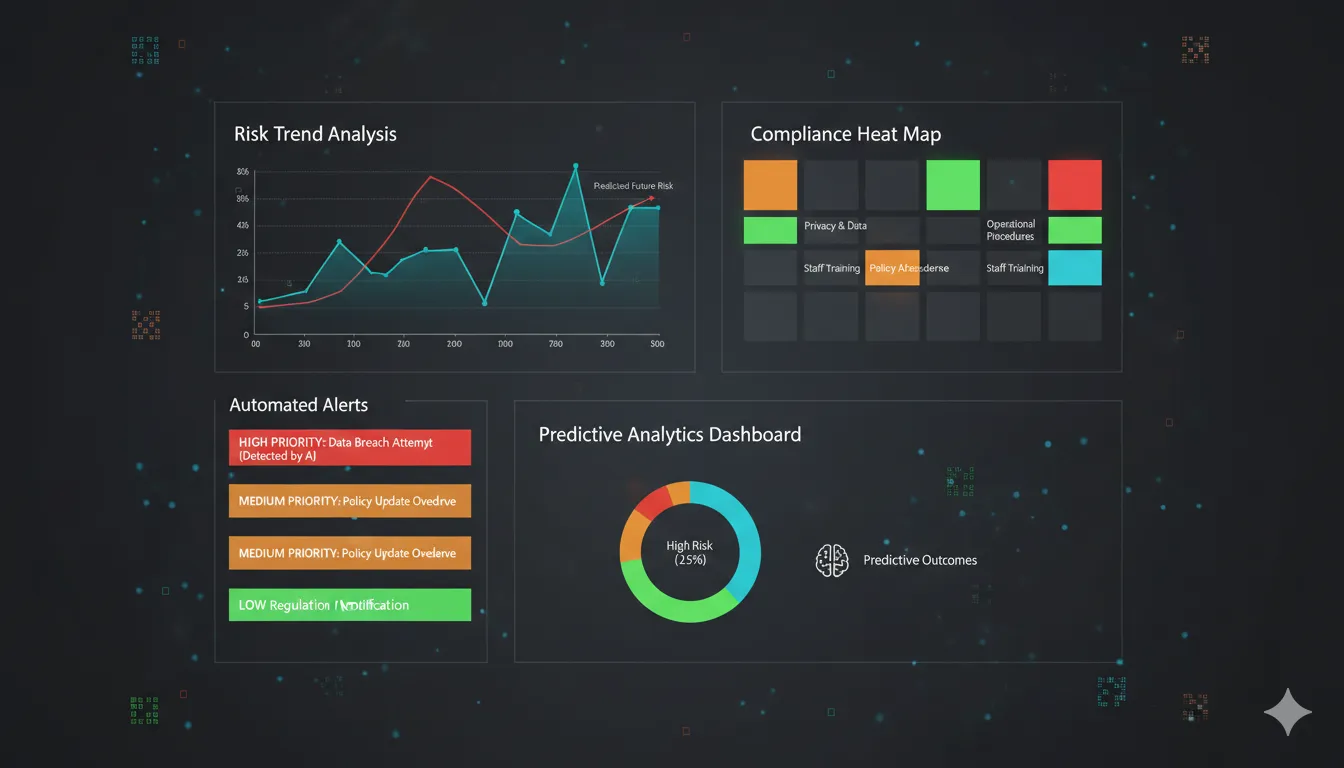
Machine learning applications analyse historical and real-time data to identify patterns, risks, and opportunities that manual systems cannot detect efficiently. This allows providers to anticipate challenges rather than react to them.
NDIS tech predictions indicate that AI-driven systems will become standard among high-performing providers by 2026.
Common AI and machine learning use cases in NDIS software include:
- Intelligent rostering based on participant needs and workforce availability
- Automated claims validation and funding reconciliation
- Anomaly detection to identify billing or compliance risks
- Workflow optimisation to reduce processing delays
These capabilities directly support NDIS software innovation by improving accuracy while lowering administrative overhead.
Predictive Analytics and Proactive Decision-Making
Predictive analytics becomes central to future NDIS technology. Advanced analytics enable providers to forecast demand, staffing requirements, and funding risks with greater confidence. Systems transform operational data into actionable insights.
NDIS software trends 2026 increasingly emphasise proactive management. Systems alert providers to potential issues before they impact participants or cash flow. This supports better planning and resource allocation.
Providers that invest early in predictive analytics gain operational resilience, improved financial control, and stronger long-term sustainability as service complexity increases.
Mobile and Remote Capabilities Transforming NDIS Service Delivery
Mobile and remote capabilities are central to NDIS software trends 2026. Providers operate across dispersed teams, regional communities, and flexible service models. Mobile-first design underpins workforce efficiency and service consistency.
Future NDIS technology prioritises real-time mobile access for support workers, coordinators, and managers. Platforms must support instant updates, secure cloud connectivity, and reliable offline functionality.

NDIS software innovation in mobile capability ensures accurate data capture at the point of care. This reduces delays and administrative rework common with paper-based or desktop-only systems. Modern provider dashboard software integrates seamlessly with mobile applications for comprehensive oversight.
Expanding Mobile Functionality Across Provider Operations
Emerging NDIS tools increasingly extend full system functionality to mobile environments. Frontline staff can manage schedules, record supports, and submit documentation in real time through mobile apps.
NDIS tech predictions indicate that providers without robust mobile platforms will face productivity and compliance risks. Mobile access supports faster communication and stronger oversight across service teams.
As NDIS software trends 2026 evolve, mobile capability becomes a core operational requirement rather than an enhancement.
Remote Service Delivery and Telehealth Integration
Remote service delivery continues to expand as part of future NDIS technology. Integrated telehealth and digital engagement tools support providers in delivering compliant virtual services.
NDIS software innovation ensures that telehealth interactions, virtual check-ins, and digital assessments are accurately captured and aligned with funding and compliance requirements. This supports audit readiness without increasing manual workload.
By 2026, telehealth-ready platforms will be a baseline expectation. These enable broader service reach, reduced travel costs, and improved accessibility for participants across diverse locations. Integrated support coordination software facilitates seamless virtual and in-person service delivery.
Learn more about implementing these capabilities with VCCG’s telehealth solutions.
Data Analytics Evolution in NDIS Software
Advanced data analytics becomes central to emerging NDIS tools, defining competitiveness for providers in 2026. NDIS software trends 2026 increasingly emphasise business intelligence, financial forecasting, and performance tracking to drive smarter operational decisions.
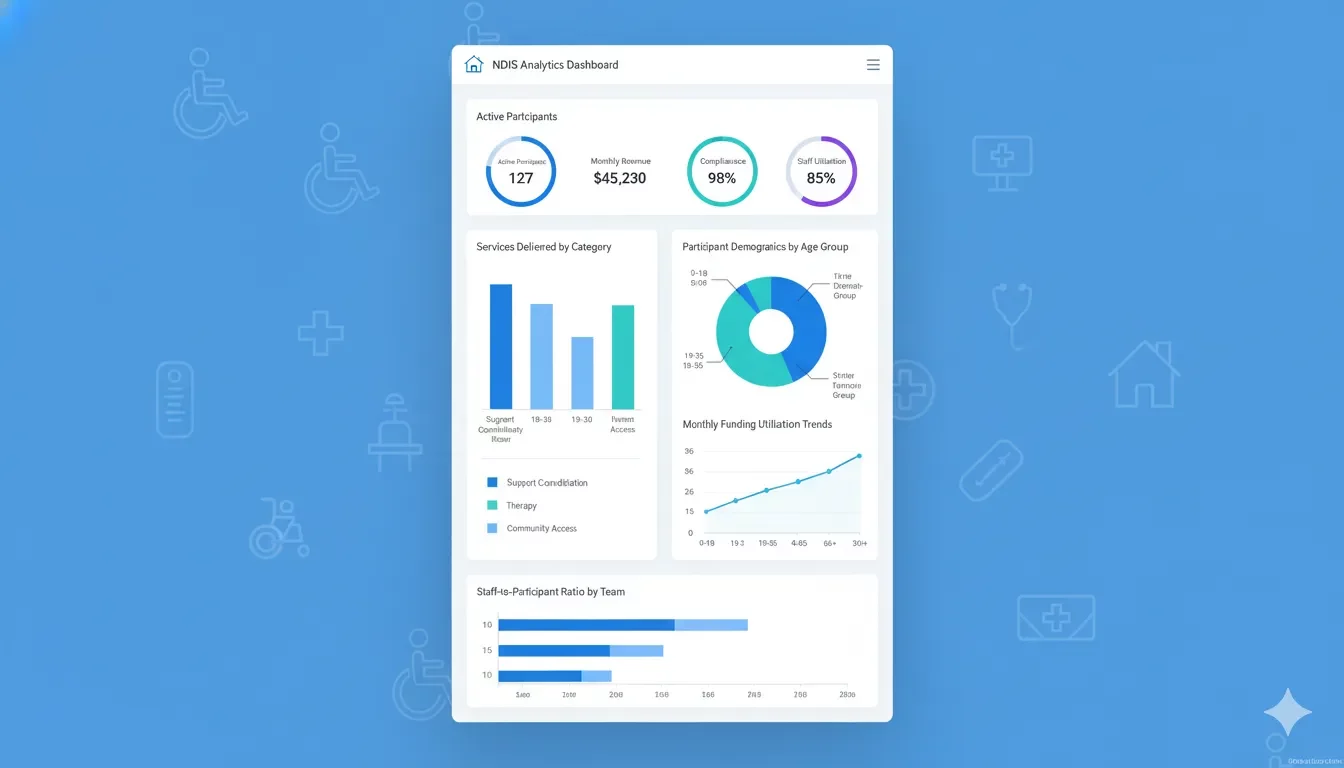
Modern NDIS platforms transform raw operational data into actionable insights through interactive dashboards, visual reporting, and predictive models. Providers gain clarity on participant utilisation, funding allocation, staff efficiency, and overall service performance.

This data-driven approach shifts provider management from reactive problem-solving to strategic, evidence-based decision-making. Data analytics ensures better outcomes for participants and operational efficiency.
Outcome Measurement and Evidence-Based Reporting
NDIS policy continues to prioritise measurable outcomes and value delivery. This increases the importance of outcome tracking and reporting in future NDIS technology. Software now supports structured measurement aligned with participant goals, funding requirements, and regulatory compliance.
NDIS software innovation enables providers to demonstrate measurable impact through real-time analytics and longitudinal reporting. These capabilities strengthen participant trust, improve transparency, and streamline audit and funding review processes.
Outcome-focused analytics will become essential for provider credibility, compliance, and long-term sustainability. By 2026, platforms that fail to deliver advanced reporting and evidence-based insights risk falling behind in both service quality and operational efficiency.
Key developments in NDIS data analytics include:
- Enhanced business intelligence dashboards for real-time operational oversight
- Predictive analytics to forecast funding, staffing, and participant needs
- Structured outcome measurement aligned with participant goals
- Longitudinal reporting to demonstrate impact and inform strategic decisions
Regulatory Technology Adaptation and Compliance Readiness
Regulatory change is constant in the NDIS landscape. This makes RegTech integration a critical focus for NDIS software trends 2026. Emerging NDIS tools are increasingly designed to dynamically manage compliance, enabling providers to stay aligned with evolving funding rules and audit requirements.
Future-ready systems automatically update rules, validations, and reporting structures as regulatory requirements change. This adaptive approach reduces compliance risk while minimising additional administrative workload for providers. Advanced HRM software ensures workforce compliance alongside operational requirements.
NDIS tech predictions indicate that static compliance models will become obsolete. Adaptive, intelligent platforms will define best practice NDIS software innovation.
Audit, Data Security, and Governance Requirements
NDIS software innovation increasingly embeds governance, audit trails, and data security into core systems. This reflects stricter sector-wide expectations from the NDIS Quality and Safeguards Commission.
Future NDIS technology ensures audit readiness through continuous documentation, system-generated logs, and transparent reporting. This reduces disruption during audits and strengthens organisational accountability.
Security-first design is no longer a premium feature. It is a fundamental requirement for any provider platform seeking long-term reliability and regulatory compliance.
Explore comprehensive compliance solutions with HiFive’s risk management tools.
Vertex360 Innovation Roadmap for 2026 and Beyond
Vertex360’s technology roadmap aligns closely with leading NDIS software trends 2026. The platform demonstrates strong commitment to innovation, scalability, and operational efficiency. Vertex360 continues investing in AI automation, advanced analytics, and cloud-based architecture to support providers as they grow.

Planned feature developments focus on delivering deeper AI-driven insights, enhanced mobile functionality, and intelligent compliance automation. These investments ensure that Vertex360 evolves alongside regulatory changes and operational demands, keeping providers future-ready.
By prioritising long-term NDIS software innovation rather than short-term feature updates, Vertex360 supports providers in building sustainable systems that adapt to emerging technology trends and sector needs. Transparent pricing ensures providers can plan their technology investments with confidence.
Intelligent Platform Design and Scalability
NDIS software innovation at Vertex360 emphasises modular design and seamless integration. This enables providers to adopt new capabilities without disrupting existing operations. The approach reduces implementation risk while allowing smooth scaling of services.
Scalable architecture supports growth across multiple regions, service lines, and participant volumes. Providers gain confidence that their technology will not constrain expansion or limit adoption of future NDIS tools.
This roadmap positions providers for operational resilience, enhanced participant outcomes, and competitive advantage in an increasingly complex and evolving NDIS market.
Strategic Planning Framework for NDIS Software Investment
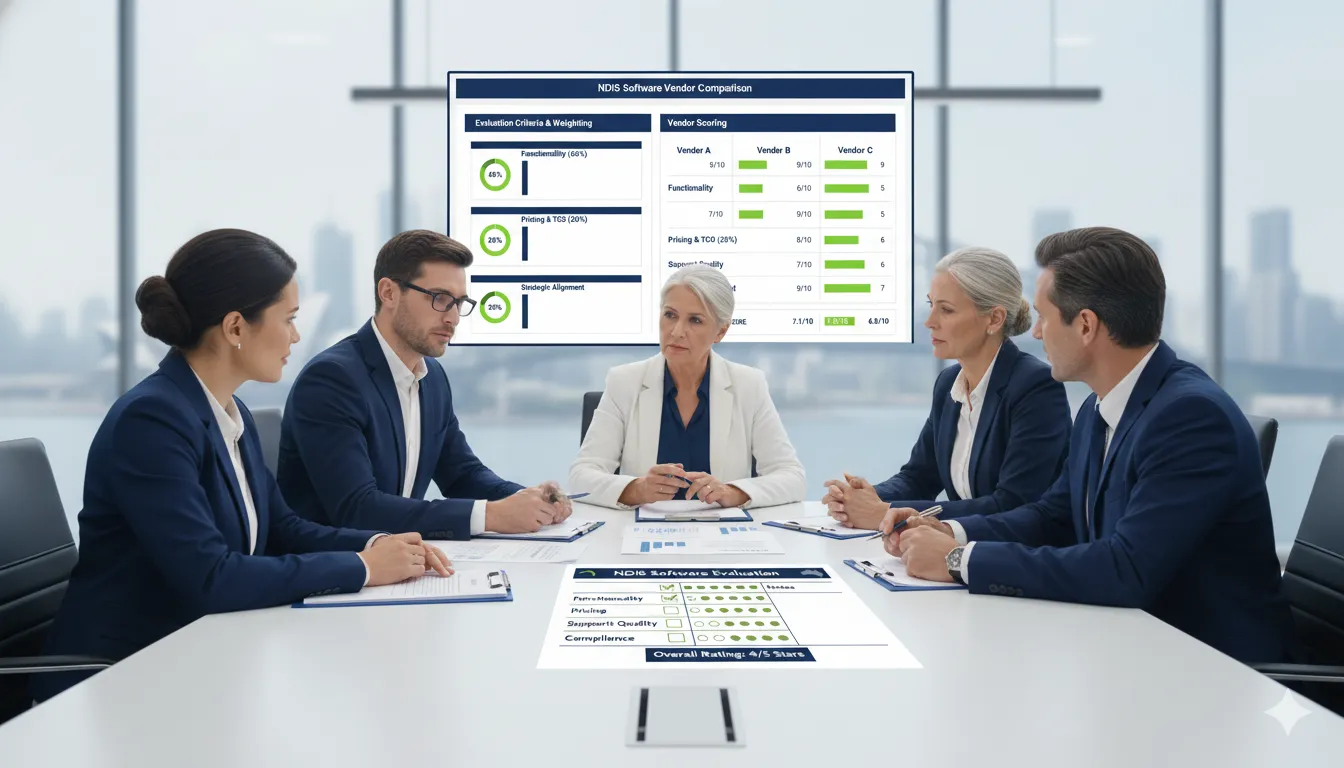
Evaluating emerging NDIS tools requires a structured planning framework that aligns with organisational strategy and long-term goals. Providers should assess how future NDIS technology enhances operational efficiency, compliance, and participant outcomes.
Technology decisions must consider scalability, vendor stability, integration capability, and adaptability. Prioritising short-term cost savings can create long-term limitations if platforms cannot evolve alongside regulatory, operational, or technological changes.
NDIS software trends 2026 emphasise selecting systems designed for continuous improvement. This enables providers to leverage emerging tools, automation, and analytics without disruption.
Aligning Technology with Provider Maturity
Different providers require tailored technology pathways based on organisational size, complexity, and service delivery models. Future-ready planning ensures that software capability matches operational maturity and growth ambitions.
NDIS tech predictions indicate that proactive planning allows providers to adapt more smoothly to workforce challenges, funding changes, and regulatory requirements. Effective software should enable strategy rather than constrain it, supporting decision making and operational oversight.
A clear technology roadmap reduces risk while maximising return on investment. This ensures providers gain long-term scalability, compliance confidence, and improved participant outcomes.
Preparing for the Next Phase of the NDIS Market
The NDIS sector enters a phase of consolidation, increased scrutiny, and performance-based evaluation. Future NDIS software innovation will support transparency, accountability, and data-driven decision making at all levels.
Providers equipped with adaptive, intelligent technology will respond faster to change, maintain service quality under pressure, and achieve better participant outcomes. Those relying on outdated or static systems risk operational inefficiency, compliance breaches, and reduced competitiveness.
NDIS software trends 2026 reflect a shift toward connected, adaptive, and intelligent platforms as the sector standard. This makes strategic software investment essential for providers seeking long-term sustainability.
Building a Future-Proof NDIS Technology Stack
NDIS software trends 2026 confirm that technology is now central to provider sustainability. AI automation, mobile enablement, advanced analytics, and regulatory adaptability define the next generation of platforms.
Future NDIS technology empowers providers to scale confidently, deliver measurable outcomes, and remain compliant in complex environments. Strategic software investment is no longer optional for competitive providers.
Providers who align early with emerging NDIS tools will lead the sector into its next phase of maturity and success.
Choose Future-Ready NDIS Technology Today
Future-proof your NDIS operations with Vertex360’s advanced software solutions. Leverage platforms built for AI automation, predictive analytics, mobile enablement, and regulatory compliance to streamline operations, scale efficiently, and deliver measurable participant outcomes.
Adopt technology that evolves with the NDIS and positions your organisation for sustainable growth.
Frequently Asked Questions
What are the top NDIS software trends for 2026?
NDIS software trends 2026 focus on AI automation, predictive analytics, mobile-first platforms, and adaptive compliance tools. Providers are adopting intelligent systems to improve efficiency, enhance participant outcomes, and scale operations across regions.
How can NDIS providers use AI and predictive analytics in their software?
AI and predictive analytics help providers forecast demand, optimise rostering, detect anomalies, and reduce administrative errors. These tools transform operational data into actionable insights, supporting proactive decision making and better participant outcomes.
Which NDIS platforms support mobile access and remote service delivery?
Modern NDIS platforms offer real-time mobile access, offline functionality, and telehealth integration, enabling support workers and coordinators to deliver services anywhere. These platforms ensure accurate data capture, compliance, and streamlined remote operations.
How does NDIS software help providers stay compliant with changing regulations?
Future-ready NDIS software integrates RegTech features, automatically updating rules, validations, and reporting to align with regulatory changes. Built-in audit trails, governance, and data security reduce compliance risk while supporting transparency and audit readiness.
What features should providers look for when investing in future-ready NDIS technology?
Providers should prioritise platforms that offer scalability, AI automation, mobile enablement, advanced analytics, and adaptive compliance. Selecting technology designed for continuous improvement ensures long-term sustainability, operational efficiency, and measurable participant outcomes.