
NDIS software team collaboration is the foundation that keeps growing providers connected, compliant, and consistent across multiple locations. When your organisation operates across more than one site — whether two offices or ten — the systems holding your teams together determine whether your service quality scales with your growth.
Most providers discover the problem only after it becomes visible. A missed incident report at one location. A compliance document expiring at another. A support worker rostered at the wrong site. These are not isolated errors. They are symptoms of a coordination gap that manual processes cannot close.
A centralised collaborative NDIS platform addresses this directly. It standardises how every site captures data, manages rosters, and reports outcomes — so leadership gains visibility without chasing updates from individual managers.
For growing providers, this is not an optional upgrade. It is the operational infrastructure that makes sustainable multi-site management possible.

Multi-Site NDIS Management: Where Coordination Breaks Down
Growth creates pressure on every system your organisation relies on. Understanding where coordination fails is the first step to fixing it.
Communication Gaps Across Locations
When teams across sites rely on email threads, phone calls, and informal messages to share participant information, critical details get lost. Case notes sit in separate systems. Incident updates never reach the right manager. During audits and incident reviews, these gaps become visible — and costly.
The NDIS Quality and Safeguards Commission requires providers to maintain accurate, accessible records across all locations. Fragmented communication systems make this requirement significantly harder to meet.
Inconsistent Service Practices Between Sites
Without standardised workflows, each location develops its own approach. One site follows rigorous documentation standards. Another uses informal methods that felt efficient at small scale. Over time, these differences create inconsistent participant outcomes and expose the organisation to compliance risk under the NDIS Practice Standards.
This is one of the most common audit failure points for providers managing multiple locations. Auditors look for consistency — in incident reporting, case notes, risk assessments, and plan reviews.
Poor Resource and Workforce Visibility
Managers at a centralised level often cannot see:
- Which staff are available across sites on a given day
- Where worker compliance certifications are due to expire
- Which location is operating below or above participant capacity
- Where unfilled shifts are creating delivery risks
Without real-time visibility, workforce planning becomes reactive rather than strategic. Participants experience the consequences directly.
Remote Workforce Complexity
Many NDIS support workers operate across multiple sites or in community and home-based settings. Without mobile-first tools, these workers rely on paper documentation or delayed system access. The result is late case note submissions, billing errors, and duplicated administrative work — all of which increase costs and reduce compliance accuracy.
The Australian Government’s digital service delivery framework emphasises real-time data access as a standard expectation for modern service providers. For NDIS organisations, meeting this standard requires purpose-built mobile access for field-based staff.
Centralised Management Features That Solve These Issues
Effective team coordination software gives every level of your organisation a single, accurate source of information.
Unified Dashboard View
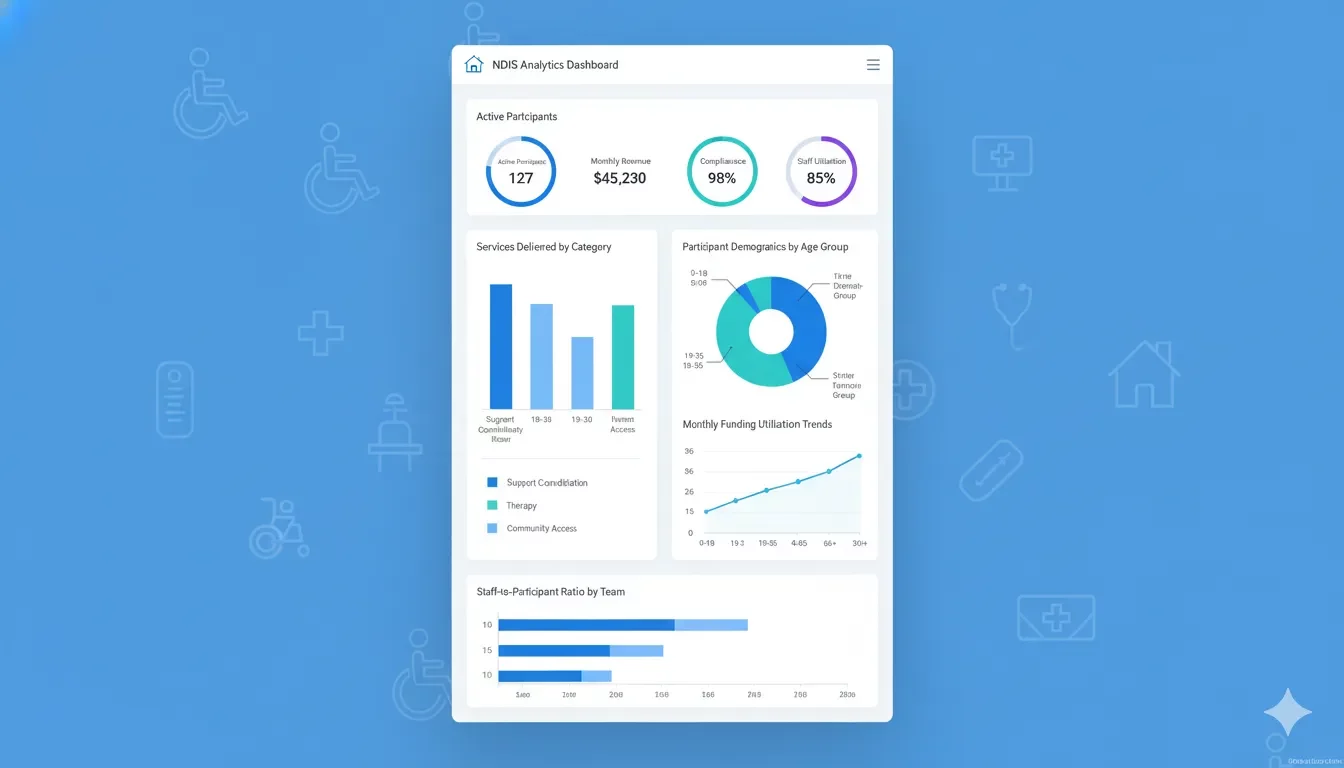
A central provider dashboard allows leadership to monitor the entire organisation from one screen. Instead of requesting updates from individual site managers, executives and compliance officers can see:
- Compliance status across all locations in real time
- Worker documents approaching expiry
- Participant goal progress and plan review schedules
- Incident reports lodged at any site
This eliminates the administrative overhead of manual reporting and removes the lag between an issue occurring and leadership becoming aware of it.
Cross-Site Reporting
Multi-site NDIS management requires reporting that reflects the entire organisation — not just individual locations. A collaborative NDIS platform makes it possible to run:
- Organisation-wide KPI tracking
- Site-level performance comparisons
- Financial and service utilisation reporting
- Audit-ready compliance exports that cover all locations simultaneously
When a Commission audit is triggered, having this reporting infrastructure in place reduces preparation time significantly and demonstrates a culture of proactive governance.
Standardised Workflow Management
Standardised templates ensure every site follows identical processes for incident reporting, case notes, risk assessments, and plan reviews. When a new site opens, these templates are immediately available — so staff do not need to develop their own approach or rely on informal knowledge transfer.
This consistency protects your organisation during audits and improves participant outcomes by eliminating process variation between locations. Explore how NDIS compliance software can enforce these standards across your entire operation.

Remote Team Management in NDIS: Tools That Keep Distributed Workers Connected
Distributed teams require real-time tools — not workarounds. The following capabilities are essential for any provider managing staff across multiple sites or in the field.
Mobile Access for Support Workers
Support workers need the ability to complete documentation the moment care is delivered — not hours later when they return to an office. Purpose-built mobile access enables workers to:
- Complete case notes immediately after shifts
- Upload incident reports and supporting documents securely
- View participant profiles and care plans on-site
- Receive roster updates and shift changes in real time
The Vertex360 Workers Mobile App is built specifically for NDIS support workers operating in the field. It reduces paperwork delays and eliminates the billing bottlenecks that come with delayed documentation.
Real-Time Notifications for Managers
Managers benefit from automated alerts that surface issues before they become incidents. Notifications can be configured for:
- Newly lodged incident reports at any site
- Worker compliance documents approaching expiry dates
- Unfilled shifts that require immediate attention
- Overtime thresholds being exceeded
This keeps operational control intact across sites without requiring managers to manually check each location’s status throughout the day. Pair this with mobile app access for managers to maintain oversight from anywhere.
Centralised Communication Attached to Participant Records
Internal messaging within a collaborative NDIS platform keeps discussions attached to the participant records they relate to. When an auditor or senior manager needs to review communication about a specific participant, every relevant note, decision, and update is in one place — not scattered across personal email inboxes, SMS threads, or verbal handovers.
Resource Sharing Across Multiple Locations
Growing providers need operational flexibility. Multi-site NDIS management software creates that flexibility by making resources visible and allocable across the entire organisation.

Cross-Site Staff Allocation
Rather than managing each site’s workforce in isolation, administrators can view staff availability across all locations simultaneously. This makes it possible to:
- Allocate workers based on skills, certifications, and location availability
- Prevent double bookings across sites
- Redeploy experienced staff to locations experiencing coverage shortfalls
- Ensure no participant is without a qualified support worker due to a scheduling oversight
The NDIS rostering software system supports this type of cross-site visibility directly, reducing the coordination overhead that grows exponentially as your organisation adds locations.
Worker Compliance Tracking Across Sites
Every support worker’s qualifications, certifications, and compliance documents are tracked in a single system. When a WWCC, First Aid certificate, or mandatory training module is due for renewal, the system flags it — regardless of which site the worker is assigned to. This prevents compliance gaps that occur when worker records are managed site by site.
For allied health providers, the allied health module extends this tracking to profession-specific requirements, including registration renewals and CPD obligations.
Equipment and Asset Tracking
Multi-site providers often share assistive devices, company vehicles, and specialist equipment across locations. Without a system tracking where assets are allocated, equipment gets lost, duplicated orders are placed, and accountability gaps appear.
Real-time asset visibility ensures resources are allocated where they are needed, reduces unnecessary expenditure, and strengthens operational accountability — areas the NDIS Commission increasingly scrutinises during audits.
Knowledge Sharing Across All Sites
When one site improves a workflow, a care approach, or a documentation process, that improvement should benefit the entire organisation. A collaborative NDIS platform makes this possible by allowing standard templates, policies, and training materials to be shared across all sites instantly. New locations gain immediate access to your organisation’s best practices — without needing to rebuild them from scratch.
For guidance on structuring your multi-site workforce strategy, the team at VCCG provides specialist consulting for NDIS providers scaling their operations.
How Vertex360 Enables NDIS Software Team Collaboration
Vertex360 is purpose-built for NDIS providers scaling beyond a single office. Unlike generic CRM platforms adapted for the disability sector, Vertex360 aligns directly with Australian NDIS regulatory requirements — so the workflows, reports, and compliance tracking it provides are built around what the Commission actually requires.
Key collaboration capabilities for multi-site providers include:
- Organisation-wide compliance dashboards that surface risk across every location in real time
- Multi-site rostering visibility through the NDIS rostering software system, showing staff availability and shift coverage across all sites simultaneously
- Worker and participant compliance tracking with automated alerts for expiring documents and upcoming plan reviews
- Real-time mobile documentation via the Workers Mobile App, enabling field staff to complete case notes immediately after service delivery
- Centralised incident management through NDIS incident management software that captures, tracks, and reports incidents across all locations in one system
- Audit-ready reporting exports from the reporting module, covering compliance, finance, and service utilisation across the entire organisation
- Role-based permissions through roles and permissions management, ensuring staff at each site see only what they need — and leadership sees everything
Vertex360’s participant-based pricing means your software costs remain predictable as your team grows. Adding staff across new locations does not increase your subscription cost — a significant advantage over per-user pricing models that penalise growth.
For providers considering a transition from existing software, the Vertex360 HRM software centralises all workforce management functions — from onboarding and compliance tracking to leave management and shift allocation — in a single system.
If you are evaluating options, exploring NDIS software for small and growing providers provides a clear breakdown of what to prioritise at each stage of your organisation’s growth.
For additional workforce coordination support, the team at HiFive works with NDIS providers across Australia on staffing strategy and team capability development.

Implementation Strategy for Multi-Site Rollout
Deploying team coordination software across multiple sites requires a structured plan. Rushing the rollout leads to inconsistent adoption and undermines the consistency the system is meant to create.
Step 1: Map Current Workflows
Document how each site currently handles rostering, case notes, incident reporting, and compliance tracking. Identify where processes differ between locations and where the most significant coordination gaps exist.
Step 2: Standardise Before Migration
Define organisation-wide templates, approval processes, and documentation standards before the software goes live. Migration is the ideal moment to eliminate site-specific workarounds that have accumulated over time.
Step 3: Phased Rollout
Start with one site as a pilot. Train local champions who understand the software well enough to support their colleagues. Measure adoption and identify friction points before expanding to the next location.
The NDIS software implementation 30-day plan provides a structured framework for this phase, covering technical setup, staff training, and early performance monitoring.
Step 4: Staff Training
Different roles require different training approaches. Managers need to understand dashboard functions, compliance reporting, and workforce allocation tools. Support workers need focused training on mobile documentation and shift management. Structured training reduces resistance and accelerates adoption across sites.
Step 5: Monitor Adoption and Outcomes
Track usage metrics and compliance improvements within the first 90 days. Identify sites or teams with lower adoption rates and address the barriers early. Use the reporting module to compare compliance performance before and after implementation to demonstrate the system’s operational value to leadership and stakeholders.
Building Sustainable Multi-Site NDIS Operations
Multi-site growth is a significant achievement for any NDIS provider. It signals service demand, community trust, and organisational capability. But without the right coordination systems, growth introduces risks that can erode the quality and compliance standards that made your organisation successful in the first place.
NDIS software team collaboration solves this. It centralises data, standardises workflows, connects distributed teams, and gives leadership the visibility they need to make informed decisions across every location.
The organisations that scale successfully are not those that add staff and sites most quickly. They are the ones that build the operational infrastructure to support that growth — maintaining quality, protecting compliance, and reducing administrative burden as they expand.
If your organisation is growing beyond a single site, the time to implement proper systems is before the coordination gaps become visible — not after.
Frequently Asked Questions
What is the best software for multi-site NDIS management?
The best software centralises compliance, rostering, reporting, and mobile documentation in one system. It provides organisation-wide visibility and site-level performance tracking. It aligns with Australian NDIS regulations and supports scalable growth without penalising providers for adding staff — as per-user pricing models do.
How does collaborative NDIS software reduce compliance risk?
Collaborative NDIS software standardises workflows and maintains audit-ready records across all sites. Real-time dashboards track expiring certifications, lodged incidents, and incomplete documentation. This proactive oversight reduces the risk of non-compliance under the NDIS Quality and Safeguards Commission framework.
Can remote support workers access participant data securely?
Yes. Authorised support workers can securely access participant records via mobile apps. They can complete case notes and upload documents in real time from the field. Role-based permissions and encryption ensure data privacy and compliance with Australian Privacy Principles.
How does multi-site NDIS software improve reporting accuracy?
Multi-site NDIS software centralises data from all locations into one system. This eliminates spreadsheet duplication and manual consolidation errors. Leadership gains accurate, real-time reporting for compliance, finance, and operational performance across the entire organisation.
What should providers consider before implementing multi-site NDIS software?
Providers should assess current workflows, compliance requirements, and staff readiness before implementation. Standardising processes prior to migration ensures smoother adoption across sites. A phased rollout with structured training reduces disruption and accelerates system uptake. The 30-day implementation plan from Vertex360 provides a proven starting framework.