
TL;DR
Choosing the right NDIS software vendor is a strategic decision that impacts compliance, efficiency, and participant outcomes. A structured NDIS software vendor evaluation framework helps providers compare functionality, pricing, support quality, long-term vendor stability, and strategic alignment. By applying clear NDIS software selection criteria, running trials, performing reference checks, and negotiating contracts carefully, providers can confidently select software that supports scalability, compliance, and sustainable growth. This comprehensive NDIS software assessment ensures decisions are evidence-based and aligned with organisational priorities.
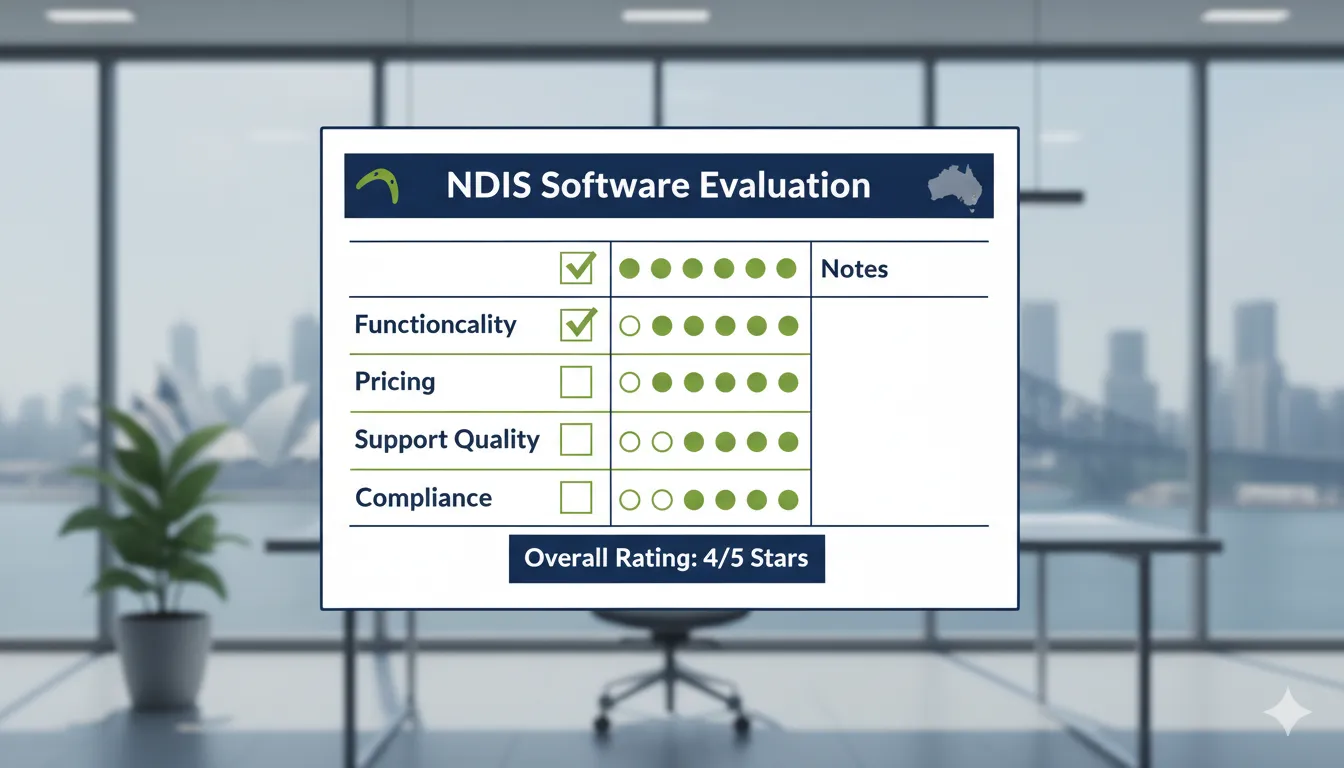
Why NDIS Software Vendor Evaluation Matters
Selecting the right technology partner is a critical strategic decision for NDIS providers managing growth, compliance, and service complexity. A structured NDIS software vendor evaluation helps providers assess whether a platform can truly support long-term operational success. In a regulated environment, software must align with both business strategy and NDIS Commission compliance requirements.
Without a systematic approach, choosing an NDIS software vendor often becomes reactive rather than strategic. This increases the risk of selecting systems that limit scalability, weaken compliance controls, or add administrative burden. Clear NDIS software selection criteria ensure decisions are guided by priorities, evidence, and measurable outcomes.
This guide introduces a comprehensive NDIS software assessment framework designed for providers conducting vendor comparison NDIS exercises. It supports informed decision-making by helping providers compare multiple vendors objectively. A structured evaluation process reduces risk and enables confident selection of software partners that support sustainable growth.
Understanding the NDIS Software Vendor Evaluation Process
An effective NDIS software vendor evaluation is a systematic process that balances functionality, risk, and future readiness. It moves beyond feature checklists to assess real-world operational impact.
NDIS providers operate in a regulated environment where software must support compliance requirements, billing accuracy, and participant outcomes. A structured evaluation process reduces uncertainty and improves decision quality.
This framework is especially valuable for providers undertaking vendor comparison NDIS exercises across multiple platforms. Vertex360’s transparent approach to vendor evaluation exemplifies this methodology, providing clear criteria and evidence-based assessment tools.
Establishing a Weighted NDIS Software Selection Criteria Framework
A strong NDIS software selection criteria framework begins with a weighted scoring system that reflects provider priorities. Not all factors impact compliance, efficiency, or participant outcomes equally, so weighting ensures decisions focus on strategic importance. Providers should also consider support, onboarding, and strategic alignment to ensure smooth adoption and long-term relevance.
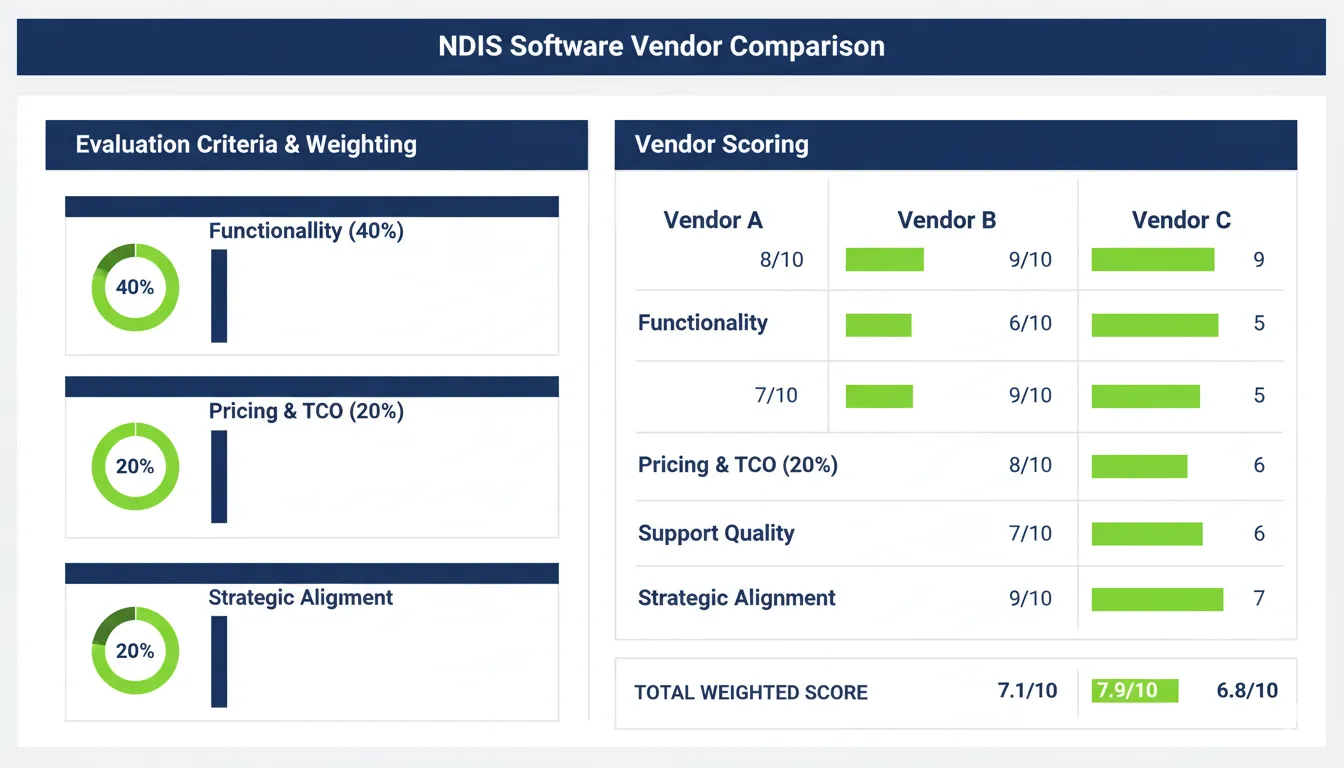
| Criteria Category | Weight | Key Considerations |
|---|---|---|
| Functionality | 40% | Scheduling, billing, participant management, case notes, compliance |
| Pricing & Total Cost of Ownership (TCO) | 20% | Subscription fees, onboarding, training, integrations, scalability |
| Support Quality & Onboarding | 20% | Vendor responsiveness, training quality, local NDIS expertise |
| Strategic Alignment | 20% | Product roadmap, automation, analytics, innovation |
Applying this weighted scoring system across all vendors allows NDIS providers to evaluate options objectively, reduce bias, and ensure the selected platform supports long-term compliance, efficiency, and participant outcomes.
Core Functionality and Compliance Capabilities
Functionality is the most visible part of NDIS software assessment, but it must be evaluated against real operational workflows. Scheduling, billing, participant management, and case notes should integrate seamlessly without manual workarounds.
Compliance capabilities are equally critical. The software must support NDIS price limits, service agreements, audit readiness, and accurate claiming according to NDIS Commission standards. Weak compliance features can expose providers to regulatory or financial risks.
During vendor comparison NDIS, providers should test systems with real-world scenarios. This ensures functionality and compliance performance are accurately scored and weighted in the evaluation framework.
Pricing Transparency and Total Cost of Ownership
Pricing is a key consideration in NDIS software vendor evaluation, but it must go beyond subscription fees. Providers need clarity on user limits, feature tiers, onboarding, training, integrations, and future scaling costs.
Platforms like Vertex360 demonstrate pricing transparency by clearly outlining all costs upfront, from the $31.50/month Total Suite to the $54/month Platinum plan, including optional onboarding fees. This transparency enables accurate total cost of ownership calculations.
A weighted scoring system ensures total cost of ownership is considered in relation to functionality and support quality. Low upfront costs may hide long-term expenses that affect operational efficiency.
By evaluating pricing as part of the weighted framework, providers can make informed decisions that balance affordability and operational effectiveness, ensuring sustainability.
Support Quality and Implementation Capability
Support quality directly impacts adoption and efficiency. During NDIS software vendor evaluation, providers should assess onboarding programs, training quality, responsiveness, and ongoing technical assistance.
Local knowledge of NDIS processes is particularly valuable. Quality vendors such as Vertex360 provide local NDIS expertise and sector-specific support teams that can address compliance challenges more effectively than generic support teams.
Strong support frameworks reduce operational disruption, increase staff confidence, and ensure smoother implementation when choosing an NDIS software vendor.
Assessing Product Roadmap and Strategic Alignment
Strategic alignment ensures the software meets both current and future operational needs. Providers should evaluate whether the vendor’s roadmap prioritises compliance updates, automation, analytics, and participant-focused innovations.
Vendors that demonstrate long-term vision and commitment to innovation are better positioned to evolve alongside the provider’s needs. Roadmap transparency signals reliability and partnership intent.
Including strategic alignment in the weighted scoring framework ensures that the selected platform supports long-term organisational goals and strengthens overall NDIS software assessment outcomes.
Vendor Financial Stability and Long-Term Viability
Assessing vendor financial stability is a crucial step in any NDIS software vendor evaluation. Providers should review funding sources, years in operation, and revenue growth to ensure the vendor can reliably support ongoing operations. Financial instability can lead to service interruptions, reduced support quality, or sudden product changes, which may impact compliance, billing, and participant outcomes.
Key long-term sustainability indicators to consider include:
- Profitability and consistent revenue growth
- Customer retention and satisfaction
- Investment in product development and innovation
- Market presence and reputation
By evaluating financial viability alongside these long-term sustainability indicators, NDIS providers can make confident, evidence-based decisions and select a software partner that supports reliable, long-term service delivery.
Structured Reference Checking and Due Diligence
A thorough NDIS software vendor evaluation must include a structured reference checking and due diligence process. Speaking directly with current or past customers provides insights that go beyond marketing materials, revealing how the software performs in real-world NDIS operations.
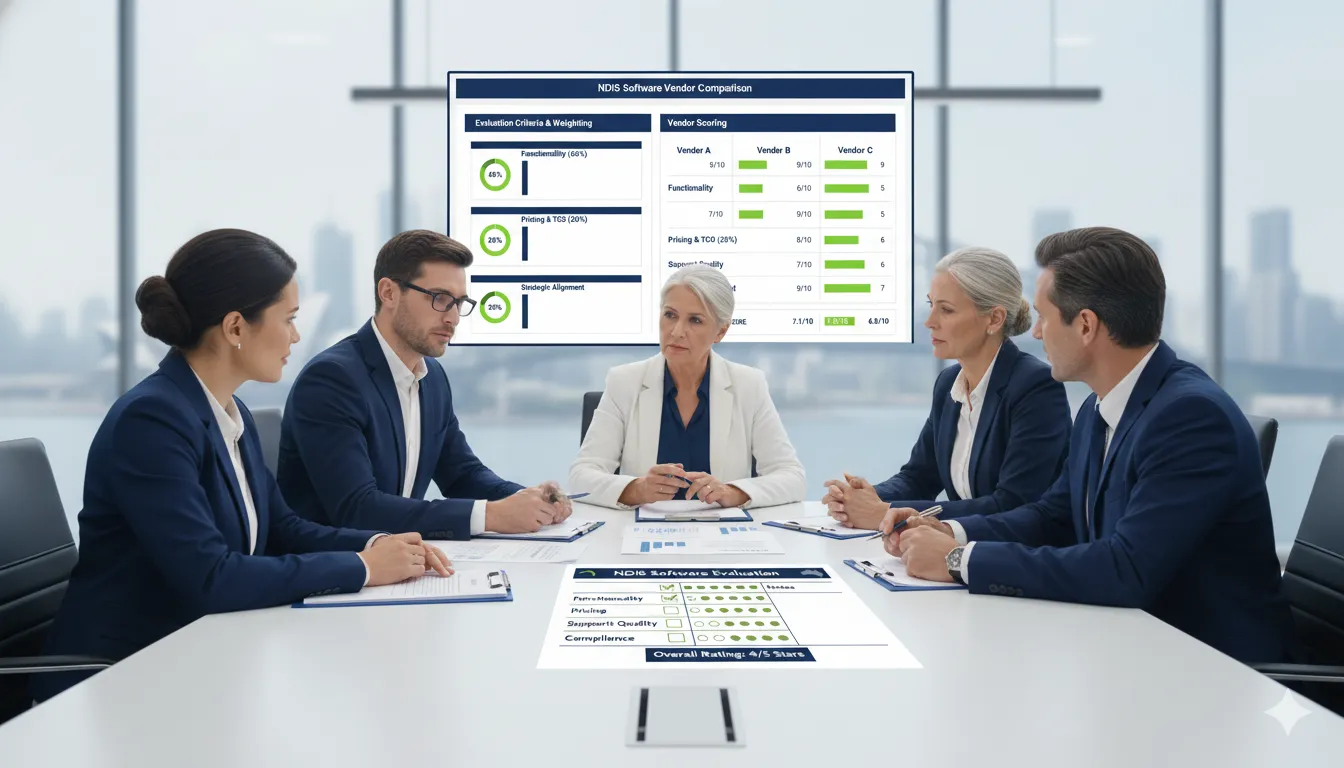
Providers should prepare targeted questions covering reliability, support responsiveness, compliance accuracy, data security, and post-implementation challenges. Asking about onboarding experiences, training quality, and vendor responsiveness during problem resolution helps identify potential risks before committing to a vendor.
A structured reference process may also include reviewing case studies, requesting documentation of compliance audits, and validating vendor claims regarding uptime, integrations, and feature functionality. Combining these steps with direct customer feedback ensures a comprehensive NDIS software assessment.
By implementing a systematic reference checking and due diligence framework, NDIS providers gain confidence in their vendor selection. This approach reduces uncertainty, uncovers hidden risks, and strengthens the decision-making process for selecting a software partner that supports long-term operational and compliance needs.
Trial and Demonstration Strategy for NDIS Software
Software trials and vendor demonstrations should be approached as validation exercises, not marketing presentations. During NDIS software vendor evaluation, providers must test the platform against real operational workflows to ensure it meets practical needs.
Demonstrations should cover all core processes, including participant management, scheduling, billing cycles, reporting, and compliance tasks. Providers should evaluate the system’s ease of use, flexibility, integration capabilities, and how well it supports everyday operational scenarios.
Consider this real-world example: A Melbourne-based provider testing three platforms discovered that only one could handle their specific roster requirements for overnight support shifts while maintaining NDIS compliance reporting. This practical testing revealed functionality gaps that weren’t apparent in initial demonstrations.
Trial feedback should be documented systematically and compared against predefined NDIS software selection criteria to enable objective scoring. Platforms like Vertex360 offer comprehensive trials that allow providers to test real workflows without commitment.
An effective trial strategy also includes assessing vendor responsiveness during the demonstration. Questions about setup, configuration, feature customisation, and support during the trial period provide insights into the vendor’s service reliability and commitment to customer success.
By following structured trial and demonstration guidelines, NDIS providers can ensure that choosing an NDIS software vendor is evidence-based, reduces risk, and results in selecting a platform that truly supports operational efficiency, compliance, and participant outcomes.
Evaluating Data Security and System Reliability
Data security is a critical consideration in any NDIS software assessment. Providers should evaluate encryption standards, access controls, backup procedures, and compliance with Australian privacy and data protection regulations.
System reliability is equally important. Downtime or performance issues can disrupt service delivery, delay claims processing, and undermine participant trust. Evaluating uptime records, redundancy measures, and disaster recovery procedures provides assurance of operational continuity.
Assessing both security and reliability protects the organisation’s reputation, ensures regulatory compliance, and safeguards sensitive participant data, making it an essential part of a comprehensive vendor evaluation process.
Contract Negotiation Essentials for NDIS Providers
Effective contract negotiation is a critical part of any NDIS software vendor evaluation. Providers should carefully review key contract terms, including service level agreements (SLAs), response times, support obligations, and escalation processes to ensure operational reliability.
Exit clauses, data ownership, and migration support are essential risk controls. Contracts should clearly define vendor responsibilities for data portability, system decommissioning, and continuity planning, allowing flexibility as organisational needs evolve.
Well-negotiated contracts protect NDIS providers in a dynamic sector. They mitigate risk, safeguard participant data, and ensure long-term access to a reliable and compliant software platform.
Stakeholder Involvement in Final Vendor Selection
A successful NDIS software assessment depends on engaging multiple stakeholders. Operational staff, finance teams, and leadership should all contribute to the evaluation to ensure the platform meets practical, financial, and strategic requirements.
Diverse input strengthens the decision-making process, reduces the risk of overlooking critical operational needs, and supports higher adoption rates. Single-decision-maker approaches often increase risk and reduce system acceptance.
Inclusive stakeholder engagement ensures that, after vendor comparison NDIS, the selected software aligns with organisational priorities and supports smooth implementation and ongoing operational success.
Final Decision-Making Framework

The final stage of NDIS software vendor evaluation combines weighted scores, trial outcomes, reference feedback, pricing analysis, and financial stability assessments. Providers should follow a structured decision-making framework to ensure selections are evidence-based and aligned with organisational priorities.
Stakeholder alignment is critical during this stage. Operational staff, finance teams, and leadership should review the evaluation results collectively to ensure the chosen platform meets practical, strategic, and compliance requirements. Inclusive participation reduces the risk of overlooked operational needs and promotes adoption across the organisation.
Documenting the rationale behind the final selection supports governance, accountability, and future review processes. A disciplined, transparent final selection process ensures that choosing an NDIS software vendor strengthens long-term operational efficiency, compliance, and participant-focused outcomes.
Common Mistakes to Avoid During NDIS Software Evaluation
Rushed decisions are one of the most frequent failures during NDIS software assessment. Time pressure often leads to incomplete due diligence, inadequate trial evaluation, and overlooked compliance risks.
Another common mistake is prioritising cost over capability. Choosing a cheaper system that cannot scale or support compliance creates hidden operational and financial costs over time.
By avoiding these pitfalls, NDIS providers can strengthen evaluation outcomes, ensure long-term platform effectiveness, and make confident, evidence-based decisions during vendor comparison NDIS exercises.
How the Right NDIS Software Supports Sustainable Growth
Selecting the right software platform directly impacts operational efficiency, compliance accuracy, and participant outcomes. The right system streamlines workflows, reduces administrative burden, and improves data visibility across the organisation.
Modern solutions also support data-driven decisions, workforce efficiency, and financial transparency. These capabilities enable providers to scale sustainably while maintaining high-quality service delivery.
Applying structured NDIS software selection criteria ensures technology acts as a growth enabler, not a constraint, empowering providers to achieve long-term success and improved participant outcomes.
Take Control of Your NDIS Software Selection
Selecting the right NDIS software vendor doesn’t have to be overwhelming. A structured NDIS software vendor evaluation framework provides the confidence and clarity needed for strategic decision-making that supports long-term operational success.
Vertex360 helps NDIS providers simplify their software vendor evaluation with a purpose-built, compliance-ready platform that enhances operational efficiency, supports participant outcomes, and aligns with long-term growth goals.
Explore how Vertex360 can streamline your NDIS software assessment, improve adoption, and empower confident, strategic decisions. Visit https://vertex360.io/ today and take control of your NDIS software selection journey.
Frequently Asked Questions (FAQs)
What are the most important criteria when comparing NDIS software vendors?
When conducting an NDIS software vendor evaluation, providers should focus on core functionality, compliance features, support quality, pricing transparency, scalability, and long-term vendor stability. Applying a structured NDIS software selection criteria ensures that every factor is objectively scored during vendor comparison NDIS exercises.
How can I ensure the software I choose will support NDIS compliance requirements?
Ask potential vendors about features that handle NDIS price limits, reporting tools, audit readiness, and data security. Verifying these capabilities through real-world trials as part of your NDIS software assessment ensures the system supports ongoing regulatory compliance.
What should I focus on during software trials and demonstrations?
During trials or vendor demonstrations, test workflows like participant management, billing cycles, scheduling, reporting, and integration flexibility. Document feedback systematically to evaluate vendors objectively, helping you make a confident decision when choosing an NDIS software vendor.
How do I assess the financial stability and long-term viability of an NDIS software vendor?
Review long-term sustainability indicators such as funding sources, profitability, customer retention, product innovation, and market presence. Evaluating these factors during an NDIS software vendor evaluation reduces the risk of service disruption or reduced support quality.
Why is stakeholder involvement important in the NDIS software selection process?
Engaging operational staff, finance teams, leadership, and compliance experts ensures the platform meets practical, financial, and strategic needs. Inclusive participation strengthens adoption, reduces overlooked requirements, and enhances the outcomes of any NDIS software assessment or vendor comparison NDIS process.