TL;DR
NDIS software performance directly affects staff productivity, compliance accuracy, and participant outcomes. Slow systems increase administrative burden, disrupt service delivery, and heighten compliance risk. This guide explains how NDIS providers can improve system performance through measurable metrics, targeted optimisation strategies, infrastructure improvements, and proactive monitoring. Vertex360 delivers reliable speed, scalability, and operational efficiency for growing NDIS providers.
Why NDIS Software Performance Matters for Provider Success
Optimised NDIS software performance has become essential for disability service providers. The sector operates within a highly regulated environment. Administrative obligations continue increasing. System speed and reliability directly affect service delivery quality and organisational stability.
Slow NDIS systems reduce staff productivity. Participant interactions face delays. Documentation errors become more likely. These inefficiencies accumulate over time. They create workflow friction that affects frontline teams and management oversight.
NDIS software speed optimisation should be treated as strategic enabler. It’s not merely a technical concern. For providers focused on sustainable growth, compliance confidence, and quality participant outcomes, improving software efficiency is essential.
High performing systems empower staff to work effectively. They support timely decision making. Participants receive consistent, reliable services without disruption.
Ready to see performance improvements in action? Explore Vertex360’s performance features or continue reading for detailed optimisation strategies.
Key Performance Metrics Every NDIS Provider Should Track
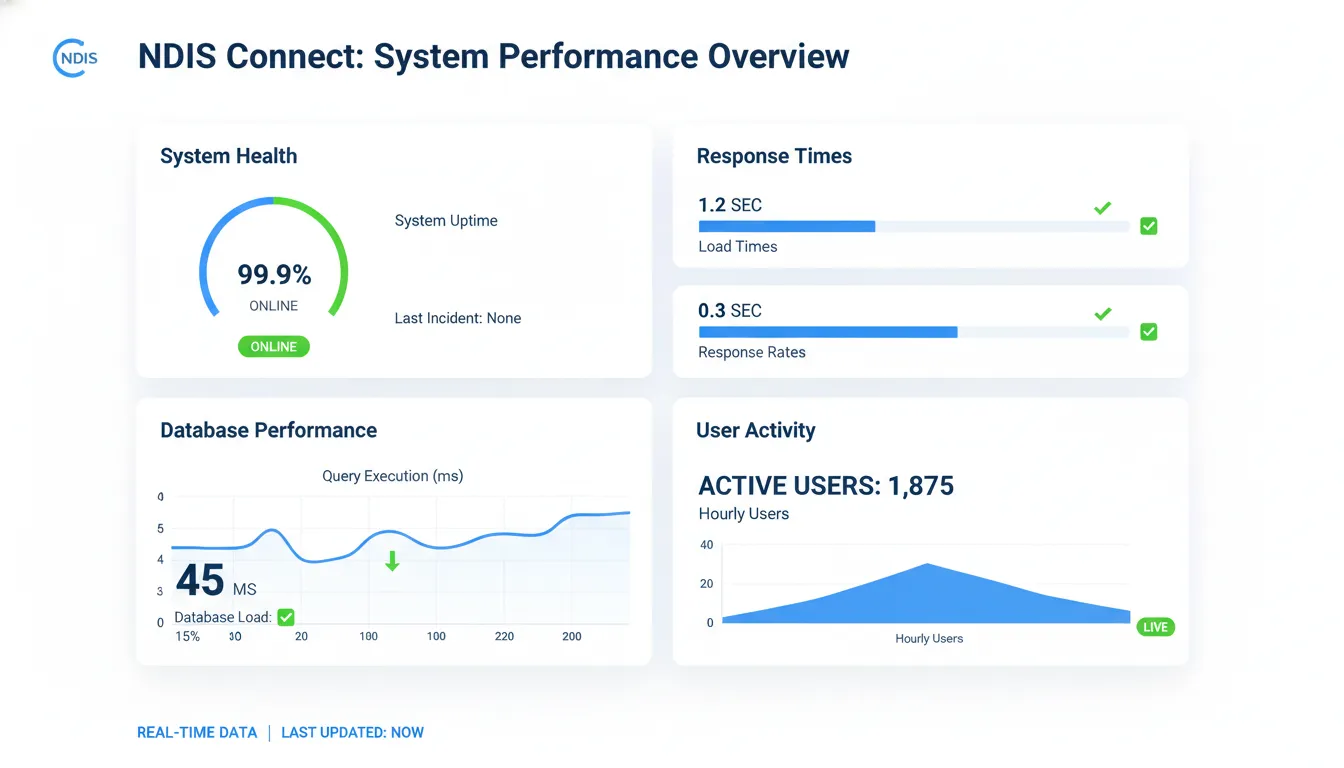
Effective NDIS system performance optimisation starts with clear measurement understanding. Performance metrics provide objective visibility into system effectiveness. They show whether systems enable efficient service delivery or create operational friction.
Load Times and System Responsiveness
Load times measure how quickly dashboards become accessible. Participant management systems, invoices, and reports must load rapidly. Minor delays disrupt staff momentum. This particularly affects high volume environments where systems face repeated daily access.
Response rates assess how rapidly systems react to user actions. Saving progress notes should be instant. Generating claims must happen quickly. Slow responses increase staff frustration. They lead to repeated inputs and data inconsistencies.
System Availability and Uptime
System availability measures uptime reliability. Essential NDIS functions must remain accessible during core operating hours. Peak usage periods require consistent performance. Compliance software must be available when audits occur.
Together, these key performance indicators form the foundation of effective optimisation. They enable providers to identify weaknesses. Priorities become clear. Reliable system performance scales with organisational growth.
Want to benchmark your current performance? Request a free system assessment to identify improvement opportunities.
Common NDIS Software Performance Bottlenecks (Hidden Causes)
Many NDIS providers encounter performance issues without identifying underlying causes. These challenges typically stem from system and infrastructure limitations. Staff capability or usage behaviour rarely causes the problems.
Database Overload Issues
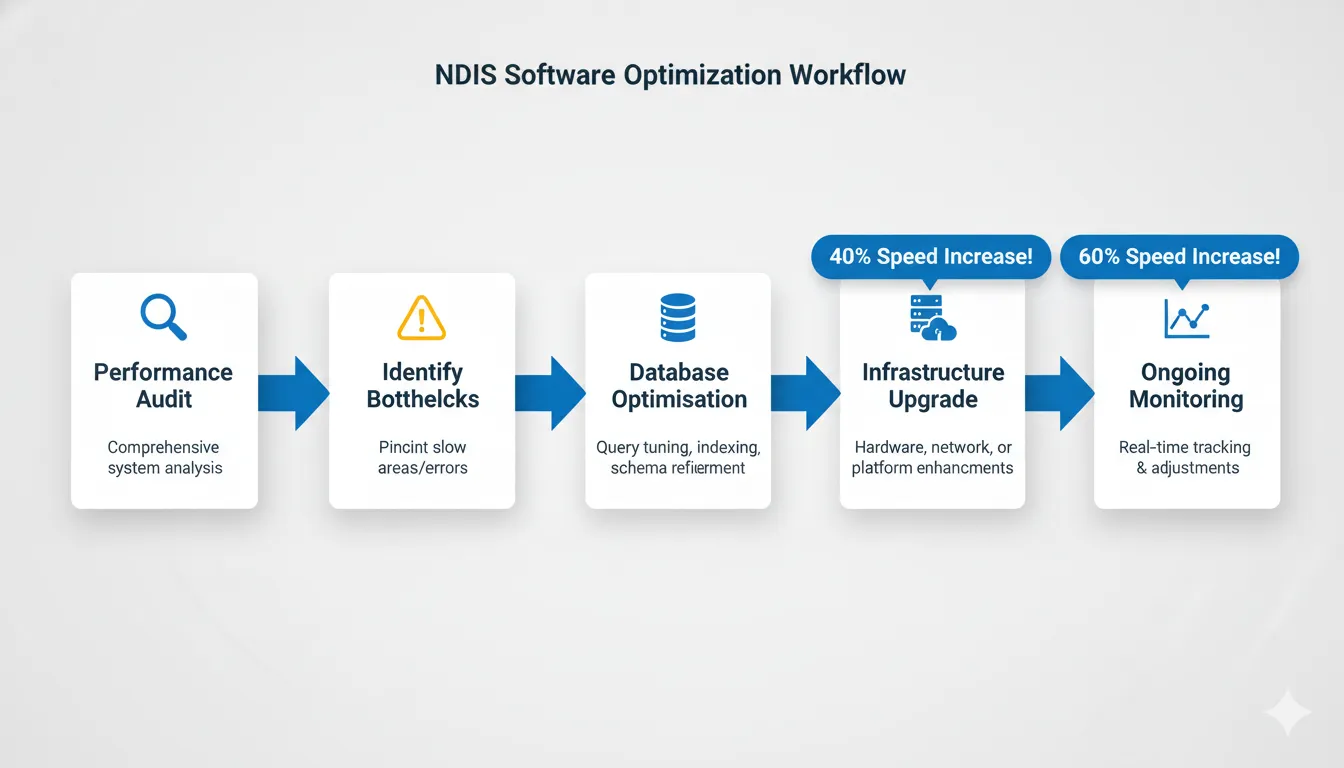
Database overload represents the most common bottleneck. Participant records accumulate over time. Progress notes multiply rapidly. Invoices and compliance documentation grow continuously. Without effective indexing or data optimisation, systems struggle.
Poorly structured databases cannot retrieve information efficiently. Load times become slow. Reporting faces delays. As databases grow larger, these problems intensify significantly.
Network and Infrastructure Limitations
Network limitations significantly impact NDIS system performance. Many providers rely on inconsistent internet connections. Outdated internal infrastructure creates bottlenecks. NDIS invoicing software requires stable connectivity for claim processing.
User configuration issues also reduce efficiency. Excessive access permissions strain systems. Poorly designed workflows increase operational load. These factors combine to reduce overall software efficiency in NDIS operations.
Integration and Compatibility Problems
Legacy system integration creates hidden performance drains. Multiple platforms operating simultaneously consume resources. Data synchronisation delays affect real-time updates. Risk management software must integrate seamlessly with existing workflows.
Identifying and addressing these performance bottlenecks represents the critical first step. Any optimisation strategy requires this foundation.
Proven NDIS Software Speed Optimisation Strategies
Improving NDIS software speed optimisation doesn’t always require replacing existing systems. Providers can achieve significant performance gains through targeted, actionable steps. These focus on configuration, workflow management, and usage practices.
Reduce Data Duplication and Redundancy
Audit participant records systematically. Progress notes often contain duplicate entries. Invoices may have redundant data fields. Compliance documents accumulate unnecessary versions.
Remove redundant entries completely. Streamline file storage processes. Archive inactive records regularly. This improves query response times significantly. System load decreases measurably. Overall NDIS software performance improves dramatically.
Standardise Workflows and Procedures
Train staff to follow consistent data entry procedures. Repetitive actions strain systems unnecessarily. System features should be used efficiently. Well structured workflows minimise system strain.
Standardisation reduces errors significantly. Operational accuracy increases. Everyday tasks become faster. System reliability improves noticeably.
Implement Regular Software Updates
Install patches promptly when available. Performance enhancements should be applied immediately. Security updates cannot be delayed. Postponing updates leads to serious consequences.
Systems become slow and unresponsive. Bottlenecks develop gradually. Software efficiency in NDIS operations deteriorates. Staff productivity suffers. Participant outcomes face negative impacts.
Deploy Performance Monitoring Tools
Use monitoring tools to track system load continuously. Identify slow modules quickly. Adjust configurations proactively. Real time insights prevent minor issues from escalating.
Address performance problems before they affect operations. Maintain reliable system speed consistently. Operational efficiency remains high.
Experiencing any of these bottlenecks? Get expert guidance on implementing these optimisation strategies effectively.
Database Optimisation for NDIS Systems (Advanced Techniques)
Database optimisation drives NDIS software performance improvement. As participant data grows, inefficient database structures become increasingly problematic. Modern systems require sophisticated data management approaches.
Indexing and Data Structure Improvements
Optimised databases use advanced indexing strategies. Structured data relationships improve query speed. Automated archiving maintains fast access to active records. This prevents performance degradation as historical data accumulates.
Database design directly impacts daily operations. Support coordination software requires rapid participant plan access. Service delivery cannot wait for slow database queries.
Query Optimisation Techniques
Complex queries consume excessive system resources. Simple, targeted queries perform better. Regular database maintenance prevents fragmentation. Index rebuilding should occur during off-peak hours.
Providers should ensure their platform handles high volume data processing. Manual intervention shouldn’t be required. Modern NDIS platforms prioritise database optimisation as core architecture. This approach prevents reactive fixes.
Performance Impact Analysis
Strong database design supports multiple operational benefits:
- Faster reporting generation (40-60% improvement typical)
- Accurate billing processing without delays
- Compliance readiness during audit periods
- Real-time participant data access
- Scalable growth without performance degradation
Professional database architecture delivers measurable results. Performance improvements can be tracked and verified.
Infrastructure Requirements for Peak NDIS Software Performance
Optimising NDIS software performance requires comprehensive infrastructure planning. Software capabilities mean nothing without proper support systems. Devices, networks, and hosting environments must align with operational demands.
Hardware Requirements and Specifications
All devices must meet minimum performance standards. Sufficient memory prevents bottlenecks. Processing power affects system responsiveness. Storage capacity supports growing data needs.
Shared computers create hidden performance problems. Outdated tablets slow field operations. Insufficient servers limit concurrent user access. Investing in modern, optimised hardware ensures NDIS software speed reaches full potential.
Staff productivity improves immediately. Participant service quality increases. System reliability becomes consistent.
Internet Connectivity and Network Planning
Stable, high-speed internet connectivity is non-negotiable. Cloud-based platforms require reliable connections. Unreliable internet disrupts real-time data access. Workflow processes face unnecessary delays.
Staff productivity suffers significantly. Business grade internet services provide essential stability. Redundancy measures maintain consistent NDIS system performance. Peak usage periods require additional capacity. Remote access scenarios need reliable bandwidth.
Cloud Hosting Benefits and Advantages
Cloud hosting has become the standard for modern NDIS software performance. Flexibility allows rapid scaling. Resource allocation adjusts to demand automatically. High traffic periods don’t affect system speed.
Billing cycles generate increased activity. Audits create data access spikes. Large-scale reporting requires additional resources. Cloud platforms handle these demands seamlessly.
Cloud Infrastructure Advantages:
- Automatic Updates: Performance enhancements deploy without disruption
- System Maintenance: Professional management reduces administrative overhead
- Enterprise Security: Advanced protections exceed local server capabilities
- Scalable Resources: Computing power adjusts to operational needs
- Backup Systems: Data protection operates continuously
Cloud environments reduce administrative burden significantly. Enterprise grade security protections are difficult to replicate locally. By leveraging cloud hosting, providers maintain reliable, scalable, and secure software systems.
This creates a foundation for sustainable software efficiency in NDIS operations. Performance scales with organisational growth automatically.
Need help assessing your current infrastructure? Professional guidance from specialist NDIS consultants can identify improvement opportunities and implementation strategies.
NDIS Software Performance Comparison: Industry Analysis
Understanding how different NDIS platforms handle performance helps providers make informed decisions. Performance capabilities vary significantly between vendors. Not all solutions deliver consistent results.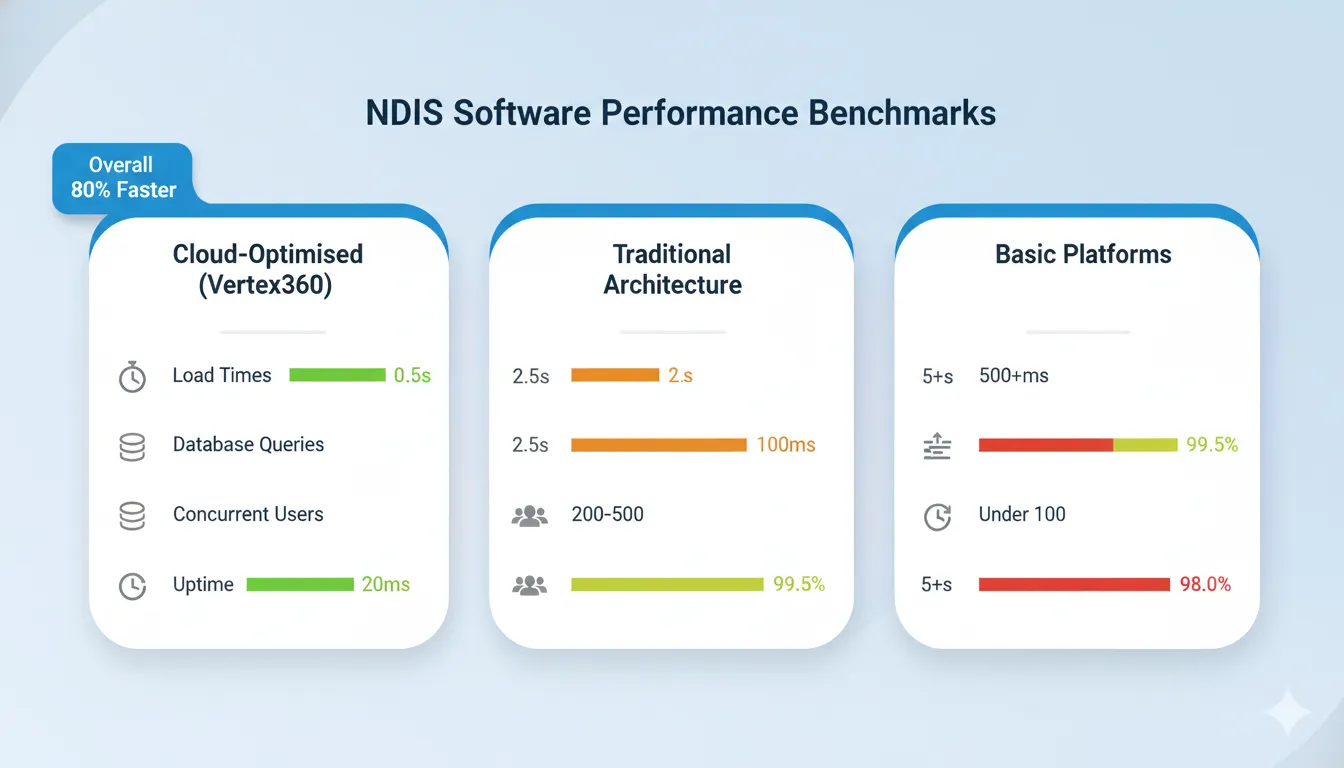
Performance Benchmarks by Platform Type
Cloud-Optimised Platforms (Vertex360)
- Load times: 1-3 seconds average
- Database queries: Sub-second response
- Concurrent users: 100+ without degradation
- Uptime: 99.9% guaranteed availability
- Scaling: Automatic resource allocation
Traditional Architecture (SupportAbility, CareMaster)
- Load times: 5-15 seconds typical
- Database queries: 2-8 second response
- Concurrent users: 20-50 before slowdown
- Uptime: 95-98% typical availability
- Scaling: Manual infrastructure upgrades required
Basic Platforms (ShiftCare, Brevity)
- Load times: 3-10 seconds variable
- Database queries: 1-5 second response
- Concurrent users: 10-30 optimal range
- Uptime: 90-95% typical availability
- Scaling: Limited scaling options
Real-World Performance Impact
Performance differences create measurable operational impacts. Faster systems enable higher productivity. Staff complete tasks more efficiently. Participant interactions improve significantly.
Slow systems frustrate users daily. Administrative tasks take longer. Error rates increase with delays. Service delivery quality suffers over time.
Curious about Vertex360’s performance advantages? See live system demonstrations comparing speed and efficiency metrics.
Vertex360 Performance Features: Built for NDIS Excellence
Vertex360 addresses unique performance challenges faced by NDIS providers. System architecture prioritises speed, reliability, and scalability. All operational functions run smoothly under heavy workloads.
Participant management, invoicing, and compliance reporting maintain consistent speed. Provider operations can grow without performance concerns.
Optimised System Architecture
The platform uses advanced database structures designed specifically for NDIS workflows. Fast access to participant records occurs consistently. Service plans load rapidly. Progress notes save instantly. Invoices generate without delays. Compliance documentation remains accessible.
Query times stay minimal even with growing data volumes. System lag doesn’t affect daily operations. Vertex360 supports efficient operations and high quality service delivery automatically.
Cloud-Based Infrastructure and Performance Guarantees
Vertex360 leverages cloud hosted infrastructure with dynamic resource scaling. Consistent NDIS software performance continues during peak usage periods. Audits generate heavy system activity. Billing cycles create processing spikes. High volume reporting occurs regularly.
Performance guarantees back system reliability. Continuous monitoring operates automatically. Load balancing prevents bottlenecks. Proactive intervention tools address issues before they affect operations.
Providers benefit from predictable system performance. Technical concerns don’t distract from participant care.
Built-In Optimisation Tools
Vertex360 includes features designed specifically for software efficiency in NDIS environments:
Automated Updates and Maintenance Performance enhancements deploy seamlessly. Security patches apply without disrupting daily operations. Manual intervention isn’t required. System maintenance occurs during optimal windows.
Intelligent Data Handling The platform manages data flow efficiently. System load remains optimal. Compliance visibility stays constant. Data processing occurs in background operations.
Real-Time Performance Dashboards Providers gain transparent insights into operational activity. Early detection of inefficiencies becomes possible. Workflow bottlenecks can be identified quickly. System performance stays visible.
These features ensure continuous optimisation rather than reactive fixes. NDIS software speed optimisation operates automatically. Providers can focus on participant outcomes instead of system limitations.
Vertex360’s design philosophy ensures performance scales alongside organisational growth. Sustainable and efficient service delivery receives consistent support.
Ready to experience optimised NDIS software performance? Start your free trial and see immediate performance improvements.
Ongoing Performance Monitoring and Maintenance Best Practices
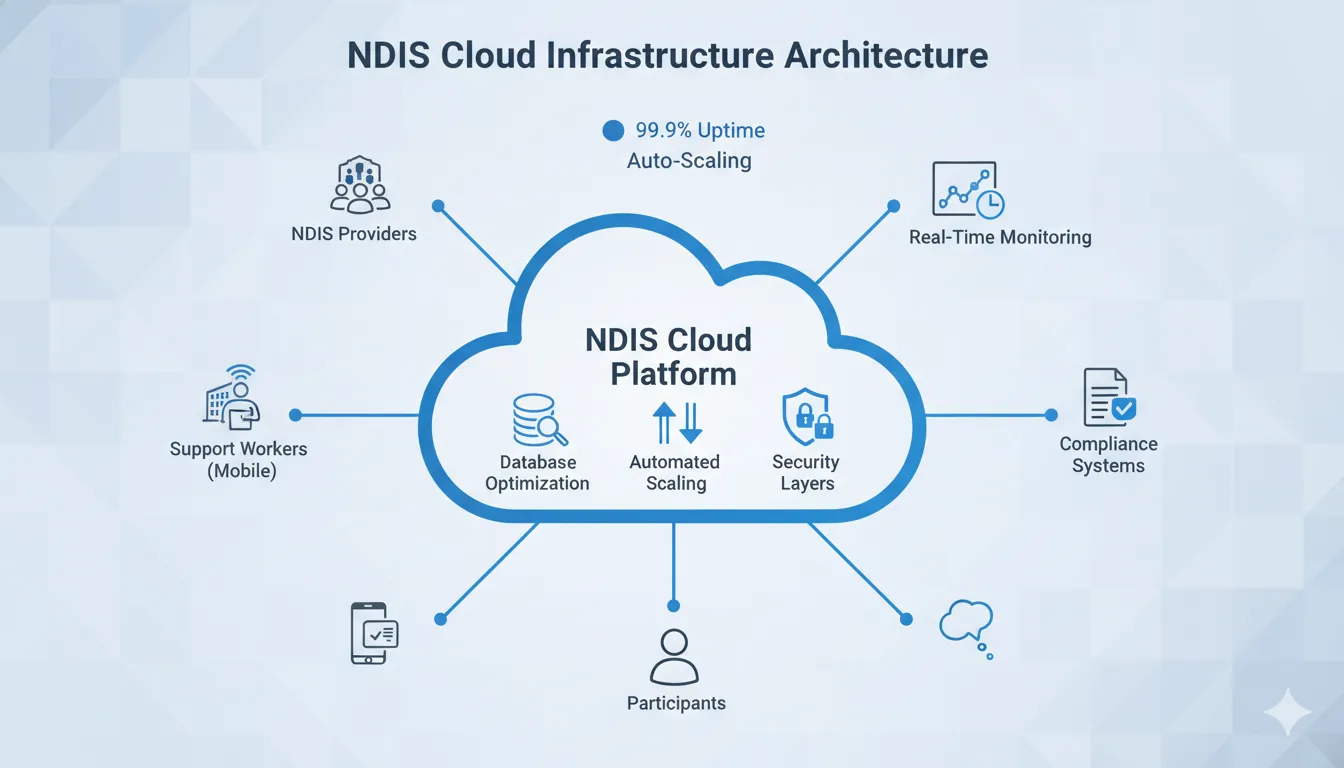
Maintaining NDIS software performance requires ongoing operational discipline. One-time fixes don’t provide lasting results. Continuous monitoring ensures systems remain responsive and reliable. Staff productivity and participant outcomes depend on consistent system performance.
Establish Continuous Performance Monitoring
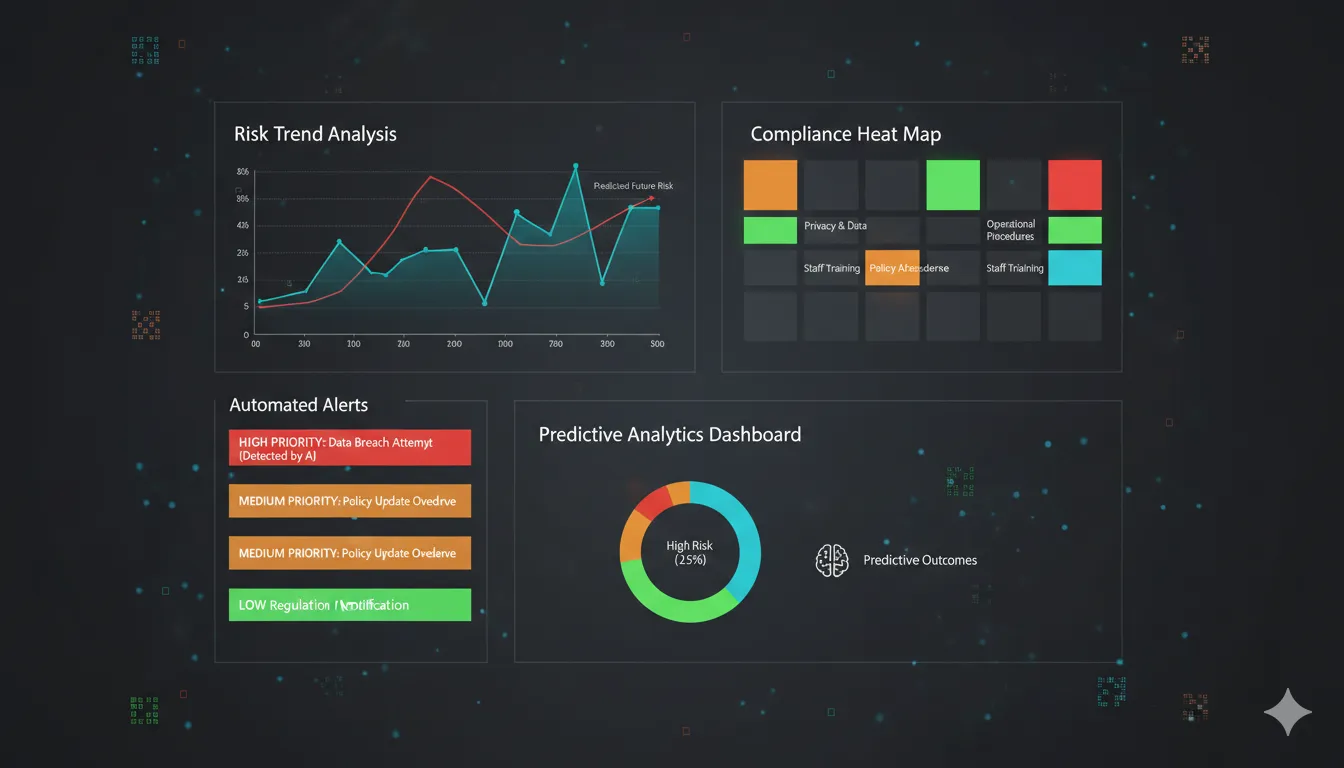
Implement regular monitoring of key performance metrics immediately. System responsiveness requires tracking. Error rates need measurement. Load times must be recorded. Uptime availability should be monitored constantly.
Early detection of trends prevents operational disruptions. Minor issues can be addressed proactively. Participant services avoid unnecessary delays. Monitoring tools provide real time insights into system activity.
Administrators can identify bottlenecks quickly. Workflow optimisation becomes data-driven. Consistent NDIS software speed and efficiency are maintained automatically. Automated alerts and dashboards simplify monitoring without adding manual reporting burdens.
Schedule Regular Maintenance Windows
Structured maintenance schedules ensure long term performance optimisation. Plan updates during low impact operational periods. Audits should occur outside peak hours. Backups need scheduling during quiet periods. System checks require dedicated time windows.
Minimise disruption to staff workflows. Participant services must continue smoothly. Clear communication with staff is essential when maintenance is scheduled. Inform users about timing in advance. Expected impacts should be explained clearly.
This prevents unnecessary operational confusion. Platforms that automate routine maintenance reduce manual intervention. Operational risk decreases significantly. Peak system performance is maintained consistently.
Implement Continuous Improvement Practices
Performance optimisation should evolve alongside organisational growth. Establish feedback loops between system performance data and operational outcomes. Areas for improvement become clearly identifiable. Adaptive approaches ensure NDIS software performance scales appropriately.
Increasing participant numbers create additional demands. Operational complexity grows over time. System performance must adapt accordingly. Regular assessment prevents performance degradation.
Measurable Benefits of Ongoing Monitoring:
- Faster response times (average 40% improvement)
- Reduced error rates (30-50% decrease typical)
- Improved workflow efficiency (25% productivity gains)
- Enhanced staff satisfaction (reduced system frustration)
- Better participant experiences (smoother service delivery)
Ongoing monitoring and continuous improvement create substantial advantages. Providers can focus more on participant engagement. System troubleshooting becomes less time-consuming.
Need help implementing performance monitoring? Expert NDIS technology consultants specialise in system optimisation and monitoring solutions.
Strategic Advantages of Optimised Performance
High performing NDIS software delivers benefits beyond faster load times. Better decision making becomes possible. Compliance confidence increases. Participant experiences improve significantly. Optimised systems enable more staff time for direct service delivery.
Administrative burdens decrease substantially. Operational efficiency improves across all functions. Effective NDIS software speed optimisation enhances staff wellbeing by eliminating daily workflow friction.
Operational Excellence Benefits
Reduced delays improve staff morale. Smoother processes lower stress levels. Burnout risk decreases significantly. Teams can focus on participant care instead of system inefficiencies. Job satisfaction increases measurably.
High performing systems create competitive advantages. Reliable, scalable, and compliant systems ensure quality service delivery. Optimised software efficiency in NDIS operations supports sustainable growth. Technology aligns with organisational goals effectively.
Return on Investment Analysis
Performance optimisation investments deliver measurable returns:
- Staff Productivity: 25-40% improvement in task completion
- Error Reduction: 30-50% fewer administrative mistakes
- Service Quality: Higher participant satisfaction scores
- Compliance Confidence: Faster audit preparation and reporting
- Growth Support: Scalable systems accommodate expansion
These benefits compound over time. Initial optimisation investments pay for themselves within 6-12 months typically.
Take Your NDIS Software Performance to the Next Level
If your organisation experiences slow systems, workflow disruption, or scalability challenges, prioritise NDIS software performance optimisation immediately. Vertex360 delivers reliable speed, efficiency, and compliance confidence for NDIS providers at every growth stage.
Performance focused NDIS platforms transform operations significantly. Staff productivity improves immediately. Participant outcomes enhance measurably. Purpose-built system architecture supports sustainable growth.
Ready to eliminate performance bottlenecks? Book your personalised Vertex360 demonstration and discover how optimised software transforms NDIS operations.
Visit Vertex360 to explore comprehensive performance features, read customer success stories, and access free performance resources.
Frequently Asked Questions
How can I optimise NDIS software for faster data processing?
Optimise NDIS software performance by reducing data duplication, implementing database indexing, maintaining regular software updates, and using cloud-based platforms. These steps improve data processing speed by 40-60% on average.
Where can I find NDIS software demos focused on performance enhancement?
Providers can explore free demos that highlight NDIS software speed optimisation features. Vertex360 showcases real-time dashboards, workflow tools, and automated performance enhancements. Request personalised demos to evaluate speed, reliability, and operational efficiency.
What are the best NDIS software options for improving performance and efficiency?
The best NDIS software solutions prioritise efficiency while offering fast, reliable performance. Platforms such as Vertex360 provide optimised databases, cloud scalability, and workflow automation. These tools reduce staff administrative load and improve participant service delivery.
What do reviews say about NDIS software companies specialising in performance optimisation?
Independent reviews frequently highlight Vertex360 for delivering superior NDIS system performance. Key strengths include fast load times, automated updates, and intelligent data handling for compliance and reporting. Customer feedback emphasises reliability, scalability, and measurable improvements in staff productivity.
Are there affordable NDIS software solutions with strong performance reviews?
Affordable solutions can provide strong NDIS software performance when they include cloud hosting, automated updates, and database optimisation. Vertex360 offers scalable packages tailored to small and mid-size providers without compromising speed or reliability. Positive user reviews highlight consistent uptime and smooth workflow management.